Santwani
Voices of the Saints
“Cross-Cultural Devotional Journey.”
- Choreography : Apeksha Niranjan
- Collaborotion : Guitarist Waldemar Rychly, Hindustani Musician and Singer Mandar Purandare
- Performance Type : Solo
- Music : Live
- Number of Musicians : 2
- Duration : 1 hour 30 minutes
- Premiere (Location) : Poznan - Poland
- Year : 2024
- Other Countries : Poland
The Artistic Vision: Unity in Diversity
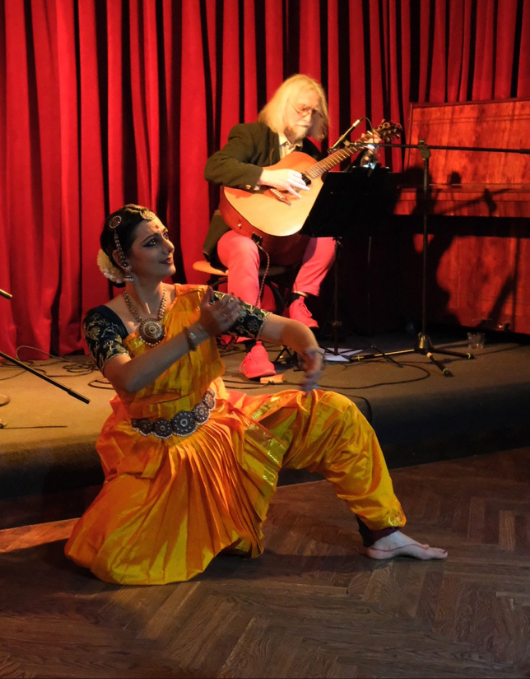
Santwani is a spiritual pilgrimage through India’s rich devotional landscape, bringing together poetry from various saints across different regions, languages, and eras. Choreographed by Guru Dr. Sucheta Chapekar, the performance demonstrates how Bharatanatyam can serve as a powerful medium to interpret and experience sacred literature from diverse traditions.
The Poetic Tapestry
The repertoire weaves together a magnificent collection of devotional poetry:
- Abhangas from Maharashtra – The ecstatic verses of Marathi saints expressing their intimate relationship with the divine
- Tulsi Das – The revered Hindi poet whose devotion to Lord Rama transformed millions of hearts
- Kabir – The mystic weaver-poet whose profound verses transcend religious boundaries
- Purandar Das – The Kannada composer known as the father of Carnatic music, whose simple yet profound compositions touch the soul
- Other Hindi poets – Various voices from the Hindi devotional tradition
The Power of Bhakti: A Universal Message
The core intention of Santwani is to illuminate the Indian way of devotion for Polish audiences. While devotion exists in every culture and geography—whether in India, Poland, or anywhere else—the paths and expressions differ beautifully. This performance showcases the distinctive Indian tradition where bhakti, the path of loving devotion, has been central to spiritual and cultural life for millennia.
Through the expressive vocabulary of Bharatanatyam—mudras, abhinaya, and rhythmic movement—audiences experience not just the words but the essence of these devotional expressions. The performance creates a bridge of understanding, showing how devotion shapes daily life, philosophy, and artistic expression in Indian culture.
An Innovative Musical Collaboration
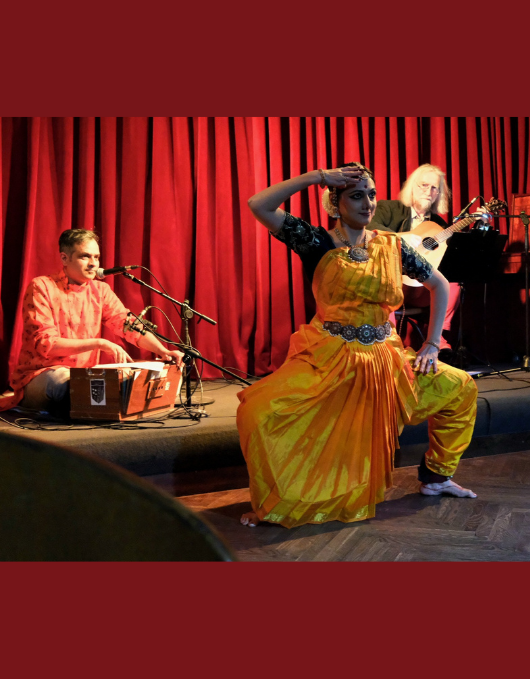
The musical ensemble for Santwani represents a bold fusion of Indian classical tradition with Western instrumentation, creating a unique sonic environment for devotional expression.
The Indian Musical Foundation
At the core is an Indian musician based in Poznan, Poland—a university Hindi teacher who embodies versatility and depth. He simultaneously serves as vocalist, harmonium player, and tabla player, bringing the authentic sound of Indian devotional music to the Polish stage. His triple role demonstrates the interconnected nature of Indian classical music where rhythm, melody, and poetry flow as one. His presence in Poland symbolizes how Indian artistic traditions continue to thrive and evolve in the diaspora.
The Western Dimension
Polish guitarist Waldemar Rieck brings a distinctive European sensibility to the traditional framework. His guitar work creates an unexpected yet deeply harmonious blend with Indian instruments, proving that devotional music can speak across cultural boundaries. This fusion respects both traditions while creating something entirely fresh—a musical conversation between East and West.
A Family Legacy
Adding a deeply personal and touching element, Rudra Mundargi—Apeksha’s son—lent his voice to several compositions in the presentation at a young age. This beautiful mother-son collaboration symbolizes the living transmission of artistic and spiritual heritage across generations, with the young artist already contributing his musical talents to the sacred tradition.
Poznan: A City of Culture
The performance took place in Poznan, one of Poland’s most culturally vibrant cities and a hub for artistic expression. Known for nurturing artists and cultural initiatives, Poznan provided the perfect setting for this cross-cultural dialogue. The city’s intellectually engaged audience brought deep curiosity and appreciation to the performance, creating an atmosphere of genuine cultural exchange.
The response was extraordinary—an audience that came to witness Indian classical dance and left with a profound understanding of how devotion shapes an entire civilization’s artistic and spiritual expression.